
Gender Pay Gap Report
Gender Pay Gap Report 2025
The gender pay gap is the difference between the average pay of men and women expressed
as a percentage. The gap is calculated across the entire workforce of an organisation and is
based on a snapshot date of the 5th of April 2025.
The gender pay gap has many contributing factors which will differ from organisation to
organisation, across sectors and across geographical locations. These factors may or may not
be unlawful or discriminatory, guided by society or cultural aspects or as a result of internal
organisational practices.
It's important to recognise that the gender pay gap is different to equal pay. Equal pay is
where there is a discriminatory pay difference between men and women who carry out the
same job, jobs rated as equivalent or work of equal value.
The existence of a gender pay gap does not automatically give rise to any discrimination or
equal pay matters.
All companies with 250 or more employees must report on their gender pay gap every year,
outlining average pay information for men and women.
Our Gender Pay Gap
We had 263 males employed by us on the 5th of April 2025 and 136 females. This is a split of
66.9% to 33.1%.
Our median pay gap is 0.0%, demonstrating that men and women earn the same at the
midpoint of the business. As the median reflects the typical employee and is not distorted by
a small number of high earners, this is a strong indicator that pay is applied fairly across
comparable roles and levels.
This is a particularly positive outcome when benchmarked against the UK, where the median
gender pay gap remains at 6.9% in 2025, meaning women typically earn less than men at the
midpoint nationally.
Achieving a 0.0% median gap therefore places us in a noticeably strong position in terms of
pay equity at the core of our workforce.
The mean hourly pay gap is 3.8% in favour of men. This reflects a small overall difference.
Our Pay Quartiles
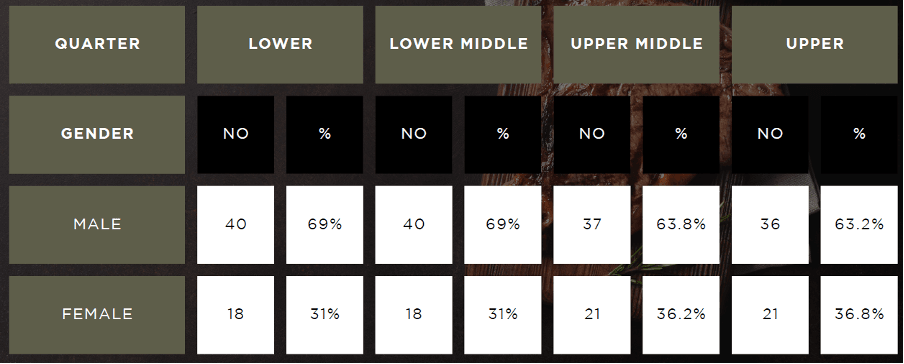
Pay quartiles are an important tool to show where we need to improve our gender balance.
The graph below shows the gender split when we divide our workforce by hourly rates of pay
and group them into four equal quartiles.
Bonus Gap
In the 12 months leading up to the 5th of April 2024, 4.6% of males and 5.4% of females received a bonus.
Our mean bonus gap is 44.2% in favour of men. The median bonus gap is 14.3% in favour of men. A single large bonus has significantly impacted the mean bonus pay. If this was not to be included, then a large positive gap would present.
The Future
While the median pay gap demonstrates strong pay parity, the mean gap highlights an opportunity to further improve gender balance in higher-paying roles. Focus will remain on progression pathways, equitable access to development opportunities, and ongoing monitoring of pay practices to ensure fairness is maintained as we evolve.
Overall, the data indicates a positive position with equal pay at the median and only a small mean gap. Continued focus on representation across pay quartiles and senior roles will be key to sustaining and further improving gender pay equity across the business.